Category: Finance

  • Bajaj & Shriram FD: 5-Year Real Experience, Returns & Risks Of High Interest FD

    Our Experience with High-Interest FDs: 5 Years Later

    We’ve put lakhs into Bajaj and Shriram FDs for over 5 years. Here is the reality of our experience—the process, the returns, and exactly what would make us walk away.

    ⚠️ Disclaimer: I am not a financial advisor or investment professional. This is purely our personal experience and should not be considered financial advice. Please consult a certified financial advisor before making any investment decisions.

    Our FD Strategy

    Why do we still invest in FDs in 2026? It gives us peace of mind and a hedge against market volatility that we don’t find in other products.

    Haven’t you heard of Debt Funds? Yes, we have. In fact, we’ve invested a significant sum in them too. Currently, our allocation is roughly 1:1 between FDs and Debt Funds. Apart from these, we also hold Pension Schemes, Sovereign Gold Bonds (SGBs), and Invoice Discounting.

    Which FDs do we hold? We divide our FDs into two baskets:

    1. Ultra-Safe / Low Yield: Banks like SBI and HDFC.
    2. High Interest / Managed Risk: NBFCs like Bajaj Finserv and Shriram Finance.

    Our allocation between “Big Banks” and “High-Interest NBFCs” is also 1:1. This keeps things simple and lets us adjust based on our immediate financial needs.

    The Reality Check: Returns & Process

    What returns are we actually getting (Feb 2026)? We typically choose 2–3 year tenures. Currently, SBI and HDFC are offering around 6.4%. In contrast, Shriram is giving us approximately 7.6%. That is nearly 18% extra interest compared to the big banks.

    Have we faced any delays or serious issues in 5 years? Absolutely not. All the repayments and principals have come back on time. Zero issues whatsoever. This track record is a big reason we continue to invest.

    Is the process difficult? Not at all. When we started, we were skeptical, so we requested a home visit. A representative called the same day and visited within 48 hours. They were professional, answered our doubts at length, and didn’t push us. We started small to build trust.

    What happens at maturity? About 7–15 days before an FD matures, the Relationship Manager calls to ask if we want to renew or withdraw. There is no “trap” or sweet-talk to prevent us from taking our money out. We have withdrawn multiple FDs at maturity with zero hassle. This transparency is the single biggest reason we keep coming back to them for more investments.

    Note on Taxation: Like regular bank FDs, these returns are taxable as per your income slab, and TDS is deducted. We factor this into our net return calculations.

    FDs vs. Debt Funds

    Why not just stick to Debt Funds if returns are similar? Debt Funds have clear advantages in liquidity and taxation (especially for long-term compounding), but the “peace of mind” is higher with FDs. In India, there is still ₹220 lakh crore in FDs compared to ₹15 lakh crore in Debt Funds. That 14:1 ratio shows we aren’t the only ones who value that stability.

    Why not use “Stable Money” or other FD apps? On paper, they are better. They offer small bank FDs with high rates and DICGC insurance (up to ₹5 lakh). However, they are app-only. While I’m comfortable with tech, my parents struggled with the app. Shriram and Bajaj win here because of their physical presence. For many, a local branch or a visiting RM is worth more than a digital certificate.

    The Risks: When Would We STOP?

    FDs aren’t “cool,” but they work for capital protection. However, we aren’t blind to the risks. We would stop investing if:

    1. Credit Rating Downgrade: Bajaj is currently AAA, and Shriram is AA+ (recently put on ‘Positive Watch’ due to the massive ₹40,000 cr investment from Japan’s MUFG Bank). If these ratings drop, we’re out.

    2. The Spread Shrinks: If the difference between SBI and Shriram drops below 10% (e.g., if Shriram only offers 0.5% more than SBI), the extra risk isn’t worth the reward. For example, currently Bajaj offers 6.9%, which is around 7-8% more than SBI. So we are not renewing our FDs there.

    3. Inflation: FDs rarely beat inflation significantly. They are a tool for protection, not aggressive wealth creation.

    My Advice for First-Timers

    Start Small: Test the water with ₹10-50K for a year. See how comfortable you are with it.

    Check the Spread: Ensure you are getting at least 15-20% more interest than your savings account or base bank FD.

    Laddering: If you want to maximise your efficiency with FDs, use this methodology


    FDs aren’t cook, but they work for capital protection. Start small, test your comfort level, then scale. Questions? Drop them below.

    Opening a new account? Consider my referral link. It helps me make honest reviews. No impact on your returns!

    WINT: Use Code C4EAEB or link
    GRIP: Link
    ALTGRAAF: Use code BH8922 or link
    GULLAK: Use Code 30Y99M or link
    TAP / Ulta: Link or code X72D1Y

  • ₹2 Lakh Investment in Wint Wealth: Complete Review After 14 Months

    During COVID, I had time at hand. Since I was just beginning my investment journey then, I started exploring and came across bond investing platforms like Grip and Wint. I had always been attracted to them but never invested because there was a lack of real, first-hand reviews.

    Slowly, I gathered the courage to start investing on my own in small amounts across different platforms and have been sharing my experiences as I go.

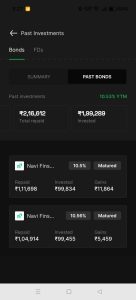
    This is my complete review of investing with Wint Wealth. I invested ₹1,99,289 across two bonds and received ₹2,16,612, achieving a 10.53% YTM with zero delays. But there’s a lot that marketing brochures won’t tell you.


    Quick Summary

    • Platform: Wint Wealth (SEBI-registered OBPP)
    • Investment: ₹1,99,289 across 2 Navi Finserv bonds
    • Returns: ₹2,16,612 (10.53% YTM)
    • Experience: Zero delays, all payments on time
    • Best for: Beginners seeking safe entry into bonds (9–11% returns)
    • Trade-off: Lower XIRR compared to other platforms, but higher comfort and safety

    About Me

    I’m not a finance expert or guru. I’m naturally attracted to fixed-income products like bonds and invoice discounting because of their low volatility and predictability.

    We are a family of four—my parents, my wife, and me—and I manage the entire corpus. Over the last few years, I’ve experimented a lot, made some risky bets, and learned a few hard lessons along the way.

    Disclaimer: This is my personal experience, not financial advice. I’m still learning, just like you.


    What Are Bonds? What Is Wint Wealth?

    Bonds are issued by governments or companies. When you buy a bond, you’re essentially lending money to them at a fixed interest rate. That’s the simplest way to think about it.

    Bonds have traditionally been used by institutions and HNIs because they offer a middle ground between stocks and FDs. Stocks are volatile—over the last 1.5 years, Nifty has given barely 1–2% returns. FD rates are around 6% for large banks and up to 8% for smaller banks. Bonds usually fall in the 9–12% range. They carry risk, but then every investment does.

    Platforms like Wint and Grip have opened this asset class to investors like us, with minimum investments starting from around ₹10,000. I genuinely think this is revolutionary.

    Wint is a SEBI-registered Online Bond Platform Provider (OBPP), which means it’s licensed to offer bonds to retail investors.

    What I like about Wint is that it feels curated rather than crowded. They usually list four to six bonds at a time instead of flooding the platform with dozens of options. As per publicly available platform data, Wint has not reported any bond defaults so far, and they also co-invest around 2% of their own money in every bond they list.


    The “Safety First” Reality Check

    The first question everyone asks is simple: is it safe?

    Most bonds offered on platforms like Wint are senior secured bonds. This means that if a company runs into trouble, senior bondholders are paid before equity holders and subordinate debt holders.

    These bonds are also backed by collateral—things like gold, vehicles, or loan portfolios of NBFCs. On top of that, Wint co-invests in every bond, which gives some comfort that incentives are aligned.

    One important thing to understand is that even if Wint were to shut down tomorrow, your bonds would still remain in your demat account. They are independent assets, just like shares.

    From what I’ve observed, Wint’s bonds usually offer a slightly lower XIRR compared to platforms like Grip. That’s the trade-off for better ratings and a more conservative approach. If you’re looking for 12–14% yields, those options exist elsewhere, but they come with higher risk.


    My Investment Breakdown: The Real Numbers

    I put my money where my mouth is. Here’s exactly what I invested in.

    Investment 1: Navi Finserv Bond (14-month tenure)

    • ISIN: INE342T07478
    • Rating: CRISIL A – Stable
    • Invested on: July 8, 2024
    • Matured on: September 13, 2025
    • Amount invested: ₹99,834
    • Interest rate: 10.5%
    • Total repaid: ₹1,11,698
    • Gains earned: ₹11,863
    • Status: ✅ Matured

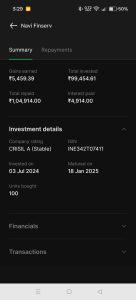
    Investment 2: Navi Finserv Bond (6.5-month tenure)

    • ISIN: INE342T07411
    • Rating: CRISIL A – Stable
    • Invested on: July 3, 2024
    • Matured on: January 18, 2025
    • Amount invested: ₹99,454
    • Interest rate: 10.56%
    • Total repaid: ₹1,04,914
    • Gains earned: ₹5,459
    • Status: ✅ Matured

    Every single payment arrived on time. No delays. No excuses.

    Initially, I kept wondering whether the money would actually show up. When the first interest payment hit my account exactly on the scheduled date, it felt reassuring. By the third or fourth payout, I had stopped checking. You just get comfortable with it.

    I chose monthly interest with quarterly principal payouts for my first investment because it gave me the highest peace of mind. I wanted some money back early, even if it meant a slightly lower CAGR. Other repayment structures are available, and this really comes down to your comfort with cashflows.

    wint wealth review wint wealth review wint wealth review


    The Investment Process: How It Actually Works

    Account creation was straightforward. The digital KYC took about 15 minutes, and the account was approved within a day.

    One thing to note is that Wint usually insists on a dedicated demat account. This helps with faster settlement and automatic tracking of interest and TDS, but it does mean managing one more account.

    When selecting bonds, I focused on credit ratings (CRISIL A or higher), repayment structure, and the issuer’s business. All reports and disclosures are available clearly, and SEBI regulations ensure these cannot be skipped.

    Once invested, the dashboard shows upcoming interest payments, principal repayment schedules, TDS deductions, and overall portfolio performance.


    Platform Experience

    The dashboard and app are very minimal. Personally, it doesn’t feel like a full-fledged investment platform, though some people may appreciate the simplicity. All essential information is available, but I would prefer more depth.

    Support is handled mainly via WhatsApp. Responses usually came within 2 to 24 hours, and the quality of replies was good. My doubts were addressed clearly, especially in the early days.

    At maturity, the money was credited directly to my bank account without any follow-ups or hassles.


    Liquidity and Taxation

    Wint allows early exit using a secondary market mechanism, but the reality is that bond markets are nowhere near as liquid as equities. I would strongly recommend investing only money you’re comfortable locking in until maturity.

    On taxation, bonds have a 10% TDS deducted on every interest payout. This is similar to FDs but very different from equity or mutual funds, where tax is applied on withdrawal. It’s something to be aware of while calculating your net returns.


    My Honest Take After 14 Months

    When I invested, my main concerns were whether the principal would come back on time and whether the promised returns would actually materialise. In reality, everything worked exactly as described. There were no delays, and support was responsive whenever I needed clarity.

    If you’re someone who dislikes stock market volatility, wants returns higher than FDs, and understands the role of debt in a diversified portfolio, bonds are worth exploring. I think Wint is among the better platforms for someone starting their bond investing journey.

    I’ve invested over ₹50 lakhs in similar products. If I were starting again with what I know now, I would begin small, understand how cashflows work, and gradually increase allocation and risk over time.


    Final Verdict

    After investing ₹2 lakhs and tracking the experience for 14 months, I’d rate Wint an 8 out of 10.

    What it does well is offer good curation, transparent information, and a predictable experience with no delays. Where it falls short is slightly lower XIRR compared to some competitors and the absence of a dedicated relationship manager.

    Wint remains part of my safer bond allocation, while I use other platforms for higher-risk opportunities. Regardless of the platform you choose, stick to SEBI-registered OBPPs and avoid anything unregulated, no matter how attractive the returns look.


    Ready to Start Your Bond Journey?

    If you’re opening accounts on any of these platforms, you can use my referral links below. They help me continue creating honest, experience-based reviews like this, without affecting your returns.


    Disclaimer: This is my personal experience, not financial advice. SEBI registration does not guarantee returns. Always do your own research and consult a financial advisor before investing.

  • How to Stay Invested During Market Volatility: Lessons from Sports, Spirituality & Life

    Markets are going through tough times. Volatility is high. The Indian rupee is falling against the dollar. Gold and silver are touching new highs. Real estate prices feel almost unrealistic. The World seems to be inching towards a war. News headlines swing between panic and euphoria every other week.

    In times like these, every investor asks the same question:

    “What should I do? Stay invested, exit, or wait?”

    The real question, however, is much deeper:

    “How do I keep myself invested — emotionally, mentally, and financially — when everything feels uncertain?”

    Because the biggest challenge in investing is not the market.
    It is you.

    Understanding Market Cycles: The Only Constant is Change

    It is not possible for markets, economies, or even personal finances to remain in one state. Highs and lows are not exceptions; they are the rule.

    Markets move in cycles just like:

    • Seasons
    • Health
    • Careers
    • Relationships
    • Life itself

    Booms are followed by slowdowns. High performance and setbacks don’t exist in isolation—they coexist. Understanding this truth is the foundation of long-term investing success.

    Yet every downturn feels like this time it’s different. Well, it never is.

    I Look for Answers in Sports

    Whenever I feel confused about markets, I look at sports.Because sport, like investing, requires perseverance. Athletes face the same psychological challenges investors do: uncertainty, setbacks, and the temptation to quit when things get difficult., 

    Think of Rafael Nadal. who battled career-threatening injuries multiple times. Experts wrote him off repeatedly, yet he returned stronger, reaching new performance heights.

    Carlos Alcaraz, young and immensely talented, suffered cramps in a major match against Djokovic and lost. It looked painful and even embarrassing. But one loss does not define a career.

    Alexander Zverev broke his ankle on court during a Grand Slam. Months of recovery followed.

    In cricket, Yuvraj Singh fought cancer while Sachin Tendulkar underwent surgery for tennis elbow. The greatest batsman in cricket history couldn’t properly hold his bat for months.

    These legends teach one thing:
    High performance and setbacks coexist.

    No athlete quits the sport because of one injury or bad season. They recover, learn, adapt, and return.

    Investing is no different.

    Spiritual Wisdom on Consistency

    Our ancient texts spoke about this long before stock markets existed.

    Maharishi Patanjali says:

    अभ्यासवैराग्याभ्यां तन्निरोधः
    (The fluctuations of the mind are controlled through practice and detachment.)

    Further, he explains:

    स तु दीर्घकालनैरन्तर्यसत्कारासेवितो दृढभूमिः
    (Practice becomes firmly grounded when done for a long time, without break, and with devotion.)

    Isn’t this the definition of successful investing?

    • Abhyasa (Practice) → Regular investing, learning, reviewing
    • Vairagya (Detachment) → Not getting emotionally attached to short-term gains or losses

    In the Bhagavad Gita, Arjuna asks  Bhagwan Krishna that the mind is restless and difficult to control. Bhagwan Krishna replies:

    असंशयं महाबाहो मनो दुर्निग्रहं चलम् ।
    अभ्यासेन तु कौन्तेय वैराग्येण च गृह्यते ॥
    (Undoubtedly, the mind is restless and difficult to control, but it can be trained through practice and detachment.)

    Markets are also restless. Prices are unstable. News is noisy.

    But your discipline does not have to be.

    The Real Risk: Emotional Decision-Making

    During volatile periods, investors make catastrophic decisions driven by emotion rather than strategy:

    • Panic-selling entire portfolios during downturns
    • Blindly buying during euphoric rallies
    • Chasing “hot” assets like gold or real estate without analysis
    • Abandoning solid long-term investments after short-term losses

    The key to successful investing isn’t predicting market movements—it’s maintaining stability when markets aren’t stable. Your emotional control is your competitive advantage.

    Planning to open a new account , Consider my referral link. It helps me make honest videos. No impact on your returns!

    ✅ WINT : Use Code C4EAEB or link  https://www.wintwealth.com/bonds/referral/invite?referralCode=C4EAEB

    ✅ GRIP : https://www.gripinvest.in/?partner_id=BHI00037IFA

    ✅ ALTGRAAF : Use code BH8922 or link https://www.altgraaf.com/signup?referrer=BH8922

    ✅ GULLAK : Use Code 30Y99M or link https://gullakapp.page.link/8gko2fEsizExNmUa8

    ✅ TAP / Ulta https://ultra.go.link/ref?adj_t=1iwdp… or code X72D1Y

    Learn to Discard — But Don’t Panic

    Staying invested does not mean holding everything forever.

    You must:

    • Review your portfolio
    • Identify fundamentally weak investments
    • Exit poor-quality assets
    • Rebalance when needed

    But this should come from analysis, not anxiety.

    Something that is a bad investment for you may be highly profitable for someone else. A high-risk stock may suit a young trader but not a retired person. Real estate might be ideal for one, illiquid for another.

    Investments are relative to:

    • Risk tolerance
    • Financial goals
    • Time horizon
    • Emotional strength

    That’s why comparison is dangerous.

    What “Staying Invested” Really Means

    It doesn’t mean ignoring problems.
    It means continuing the process.

    ✔ Keep learning
    ✔ Keep reviewing
    ✔ Keep adjusting
    ✔ Keep investing regularly
    ✔ Keep your long-term vision intact

    Just like an athlete keeps training even when injured — maybe differently, but consistently.

    Final Thought

    Life, sports, spirituality, and markets teach the same lesson:

    You will fall.
    You will face setbacks.
    You will doubt yourself.

    But the winners are not those who avoid downturns.
    They are those who stay in the game.

    So keep moving.
    Keep learning.
    Keep practicing.
    Keep detaching from noise.

    Because markets, like life, always move in cycles.
    And the cycle turns in favor of those who stay invested.

    ************************

    Planning to open a new account , Consider my referral link. It helps me make honest videos. No impact on your returns!

    ✅ WINT : Use Code C4EAEB or link  https://www.wintwealth.com/bonds/referral/invite?referralCode=C4EAEB

    ✅ GRIP : https://www.gripinvest.in/?partner_id=BHI00037IFA

    ✅ ALTGRAAF : Use code BH8922 or link https://www.altgraaf.com/signup?referrer=BH8922

    ✅ GULLAK : Use Code 30Y99M or link https://gullakapp.page.link/8gko2fEsizExNmUa8

    ✅ TAP / Ulta https://ultra.go.link/ref?adj_t=1iwdp… or code X72D1Y