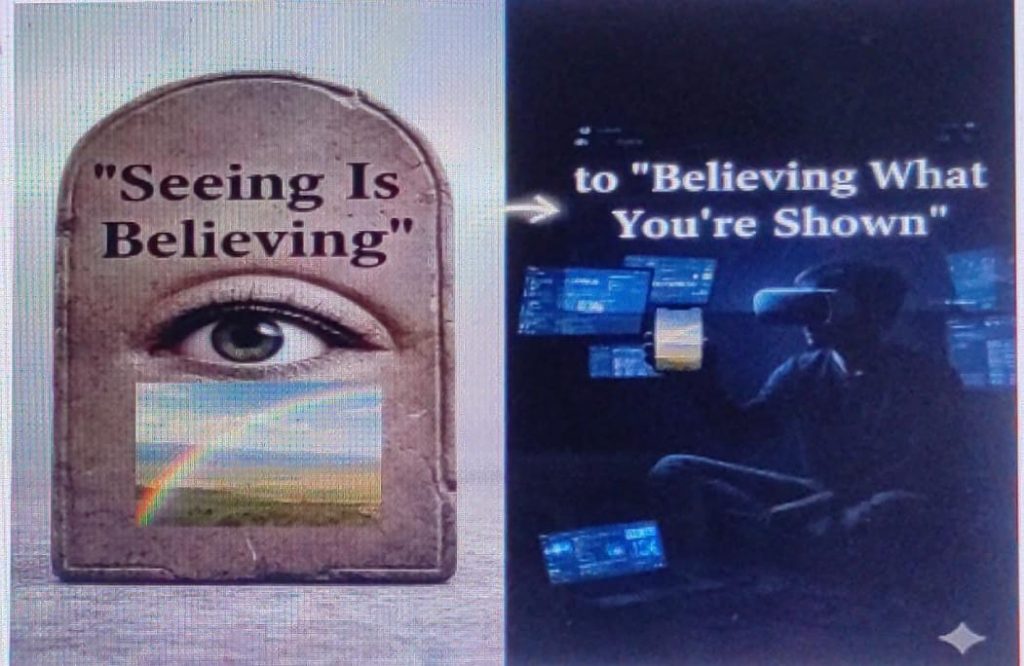
From “Seeing Is Believing” to “Believing What You’re Shown”
There’s an old saying: “Seeing is believing.” For generations, we trusted our eyes over our ears. कानो का सुना हुआ गलत हो सकता है, आंखों का देखा हुआ ही विश्वास के योग्य है। (What we hear can be wrong, but what we see is trustworthy.)
But today, that wisdom has been turned on its head.
Now, the real opinion makers aren’t our own eyes—they’re app platforms. These digital gatekeepers show us something, and through careful design and endless repetition, they make sure we believe it.The screens we stare at have become the new storytellers, and we’ve become their captive audience.
Welcome to the Era of Digital Dictatorship
We are entering an age of digital dictatorship. The real power no longer rests with governments alone. It has shifted to tech platforms that harvest our data, track our every move, and shape what billions of people see each day.
These companies have outgrown their original purpose. They’re no longer just communication tools connecting friends and family. They have evolved into political actors with frightening abilities: they can influence elections, destabilize entire societies, and decide what information counts—and what gets buried.
As the saying goes, “Knowledge is power”—but in this new world, controlling information is absolute power.
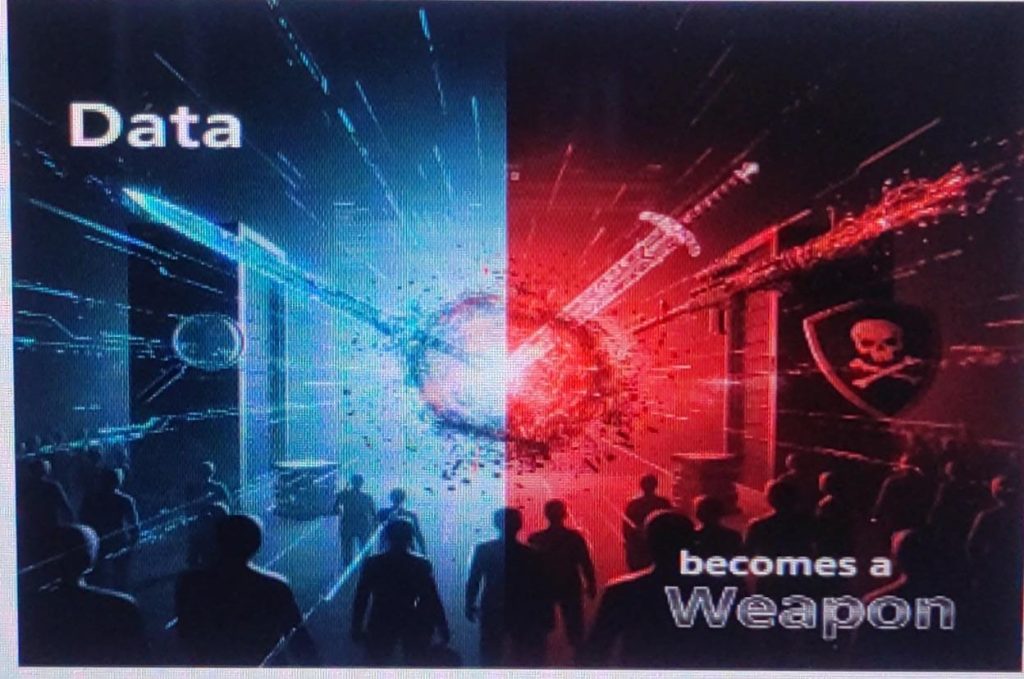
When Data Becomes a Weapon
The Cambridge Analytica scandal wasn’t just a headline—it was a wake-up call. It proved that data can be weaponized to manipulate voter behavior and tilt the outcomes of major democratic events. What many dismissed as an isolated incident is actually part of something much larger: a global system of surveillance capitalism, where our privacy is traded away for profit and control.
Every click, every like, every scroll is recorded, analyzed, and used to predict—and influence—our next move. We’ve handed over the keys to our minds without realizing what we’ve lost.
Democracy Unprepared
The harsh truth? Democracies are unprepared for this seismic shift. Laws and regulations are playing catch-up, stumbling far behind the pace of technology. Meanwhile, individuals surrender their personal information daily, often without understanding the price they’re paying.
“An ounce of prevention is worth a pound of cure.” But we’re already deep into the disease.
What we need now are clear red lines:
Strict rules on how data can be collected and used
Transparency in how algorithms decide what we see
Accountability for the massive role these platforms play in shaping politics and society
Without these guardrails, democracy itself is at risk.
The Urgent Question We Must Answer
Here’s the question that should keep us all awake at night:
If technology has become the most powerful political force in the world, how do we stop democracy from being hollowed out from within?
The digital dictatorship isn’t coming—it’s already here. The tools that promised to connect us are now dividing us. The platforms that promised freedom are now controlling what we think, feel, and believe.
As another old saying warns us: “The road to hell is paved with good intentions.” Technology gave us convenience. But the price? Our autonomy, our privacy, and perhaps our democracy itself.
The time to act is now. Before what we see, what we think, and what we believe is no longer ours to control.
What do you think? Are we sleepwalking into a digital dictatorship, or can we still reclaim control? The choice—for now—is still ours to make.
Most of us want to learn how to invest — so we can make good money. People join communities, buy courses, and follow experts. Nothing wrong with that.
But I’ve observed a simpler skill that can make both investing and living better. It’s something we can learn easily — and it’s not talked about enough. It’s how to buy better — or, how to spend better.
I’ll share three basic things on why this matters, and how it can quietly change your relationship with money.
Why This Matters
How we buy things says a lot about how we think about value — whether it’s buying groceries, an iPhone, or investing in gold or mutual funds. Our approach to spending reveals how we perceive worth and make decisions.
Is haggling over the price of tomatoes worth it? Maybe. But how much time and mental bandwidth are we willing to trade for a few rupees? Because our habits shape our mindset.
If we lack patience and long-term clarity over small purchases, chances are we’ll struggle with the same when making bigger ones — like buying stocks, a car, or a home.
When you develop a better value system in everyday buying, it reflects in your bigger financial choices — and ultimately, in the quality of your life.
1. Frugal Is Not Smart
I used to think being frugal was the same as being smart. But over time, I realized that saving money and spending it well are two very different skills.
Impulsive buying is not good — it’s emotional, short-term, and unplanned. But extreme frugality isn’t smart either. It can make you miss out on opportunities to improve your quality of life.
When you value only money, you forget that things hold value too. You trade money for time, comfort, and mental peace — and that’s perfectly valid. This mindset applies to investing as well. Being frugal doesn’t always give you the best outcome for your money.
2. My Learnings from Business
In business, how well you spend directly affects how well you earn. I’ve learned lessons here that apply deeply to personal finance.
In personal life, it’s simple: if you earn ₹100, you divide it between needs, wants, and savings. But in business, those same ₹100 must be allocated among marketing, team, product R&D, and operations — all while maintaining margins and ensuring long-term growth.
That process teaches perspective — the importance of spending strategically on things that may not give instant results but create compounding value over time.
The same principle applies to personal investing and living well. Sometimes, the best decisions are the ones that don’t pay off immediately but build lasting returns.
3. Not Falling into Analysis Paralysis
When you focus on the process, you stop being controlled by outcomes. Success or failure — especially in investing — is rarely fully in your control.
Doing your due diligence is important, but trying to time every purchase perfectly or waiting for the “best deal” often leads to analysis paralysis.
Learning how to buy better helps you trust your process. You make decisions with calmness and confidence. Over time, your ability to evaluate things improves, your decision time reduces, and your chances of getting better outcomes increase — all while staying composed, even through failures.
Before You Learn to Invest — Learn How to Buy
So before you learn how to invest — learn how to buy. Every purchase is a small test of judgment, patience, and awareness.
Because the truth is, good investing doesn’t start on a trading app or reading about MF alfa ratios— it starts every time you reach for your wallet.
Next time you’re about to buy something, ask yourself: “What value is it adding to my life?”
That single question can quietly change your relationship with money — and over time, your life.
How small changes made AI feel more like a thinking partner than a tool.
Intro
My usage of AI has gone up drastically in 1 year. I spend more time on ChatGPT + Gemini + Perplexity + Claude together, than any other website or segment.
But over the last few days, I have noticed thatI am learning to use it better.
These aren’t big, technical breakthroughs. They’re small, day-to-day shifts that have changed how I interact with AI Here are my top 3 learnings from the last month — simple tweaks that made a big difference in how AI fits into my work and life.
Earlier, I used to type prompts like I’d write a Google search — short, quick, and direct. That worked okay, but the replies often felt generic.
Over time, I started structuring my prompts in three parts: Context, Task, and Tone. Something like:
“Context : I am 28 years old. My salary is 80,000 per month. I live in Noida. You are a personal finance expert helping me plan my monthly budget.
Task: Suggest a spending breakdown that balances quality of life & savings.
Tone: Practical and realistic, not preachy. Give rationale behind your approach”
It’s simple, but that one change made a huge difference. The responses felt more thoughtful and closer to what I actually meant. Whether I tried it on ChatGPT or Claude, the difference was clear — the AI seemed to “get” my intent better.
Takeaway:Treat prompts like briefs, not searches.
2. Top-Down Approach for Bigger Tasks
When I started using AI for larger things — like a monthly marketing plan or blog structure — I used to dump everything into one long prompt. The results were usually messy and hard to fix.
Now I take a top-down approach. I start with the basics — title, structure, sections. Then I move to subpoints. And only after that do I ask for detailed content.
It’s like building a skeleton before adding the flesh. That small shift changed everything. The process feels calmer and more deliberate. Instead of rewriting confused outputs, I refine them layer by layer. The final result is sharper — and I have better understanding of how I reached it.
Old approach:
“Make a complete 30-day marketing plan for an online t-shirt store.”
Result: Big wall of text. Confusing order. Hard to tweak without breaking everything.
New approach:
Step 1: “List 5–6 key marketing areas for an online t-shirt store.” Step 2: “Create a week-wise outline for those areas.” Step 3: “Now, fill each week with specific actions and sample captions.”
Result: Layered structure. Easy to modify. Each stage builds logically into the next.
(Interestingly, this mirrors how AI itself works best — when tasks are broken into smaller, structured steps.)
Takeaway:Structure first. Content later.
3. AI for Personal Finance & Travel Planning
We take a 15-day trip almost every quarter. And in the last two, I’ve leaned on AI for everything — budgeting, itinerary, hotels, the works.
I usually write a short, 5-6 line brief: where we’re going, how many days, and what kind of travellers we are. Within seconds, it gives me a full plan — estimated costs, travel routes, even food suggestions.
What really surprised me was the accuracy. The final spend was within about 5% of what AI had predicted. That’s not just luck — that’s a hint of genuine intelligence.
It’s not perfect, of course. Some suggestions are too generic, or miss the local feel. But it gives a solid starting point — something you can tweak and make your own. And that’s the part I love: the heavy lifting is done, so you get to focus on the fun parts.
Bonus Tip — Cross-Check Everything
A small practice that’s helped a lot — run the same query through another AI tool. I usually cycle between ChatGPT, Gemini, Perplexity, and Claude. It’s like asking for a second (or third) opinion.
Each model has a slightly different strength. Sometimes one catches what another misses.
Takeaway:Two AIs are better than one.
Closing
Looking back, these three learnings — smarter prompts, top-down thinking, and practical use — all point to the same thing. AI hasn’t just made me faster; it’s made me think more clearly.
The better I brief it, the better it briefs me back. And that’s the real shift — it’s less about AI getting smarter, and more about me learning how to think with it.
For over a year, this little Victorinox Kitchen Knife has been my go-to kitchen buddy. It’s chopped, sliced, and peeled its way through countless meals, leaving me consistently impressed. Having used it extensively, I wanted to share a detailed review on why I think this is the best knife for kitchen, and why it might be perfect for you too.
2. Summary & Highlights [After 1.5 Year of Using this Everyday]
The Good Bits
Visual Aesthetics & Design – It looks elegant, premium
Physical Design & Form Factor – The handle is made with textured plastic and offers a comfortable, strong grip, even when wet.
Functionality, Performance & Comfort – Cuts easy & accurate, with a lot of confidence.
Cleaning, Storing & Sharpening – Easy to clean & store. Haven’t felt the need yet.
Price – I bought it for 490. For the brilliance it offers, I believe it is high value for money.
Should you buy this – In My opinion, yes, without any ifs & buts. It will make your life better.
The Not So Good Bits
I can’t think of anything that is a real downer. So, I would mention the points that would have made the experience even better.
I wish it came with a knife sharpener. Or some info on how to sharpen it, as i have not sharpened this kind of blade before.
I wish it is more easily available in local market, so that people can actually feel it before they buy.
Not so great for chopping Potatoes.
If this unpaid, unbiased review has helped you, consider buying the product from this affiliate link, or you can also support me buying these cute little stickers here. I love them, and I am sure it will bring a smile to you & your loved ones.
3. Research, Order & Delivery
At the time of purchase, I could not find clear info on what this knife was suitable for. Some said it is good for tomatoes only, some said it is good for half of veggies used in Indian kitchen and so on. I remember seeing a video by Honest Kitchen by Chef Bhupi, who recommended this as an all rounder knife for Indian kitchens, and I went ahead with the purchase.
Victorinox Kitchen knife comes in 2 blade types – (1) Serrated Blade and (2) Straight Edge and 2 blade lengths (1) 8cm and (2) 10cm. I purchased the 10cm Serrated Blade variant from Amazon. This delivery & packaging were standard.
4. Elegant & Outstanding
This Victorinox kitchen knife has a no-frills but elegant design. The 10cm blade looks like it has been built with superior grade steel. The handle shape & colour, make it look better than most knives I have seen in most Indian kitchens.
5. Functional Design
The blade is a 10cm serrated type, that is usually recommended for cutting, peeling & chopping of veggies. The handle of the knife is built with textured Polypropylene and offers an excellent grip, even when wet. The knife feels balanced and sturdy while using, and gives a lot of confidence while cutting. To be honest I did not know so many adjectives could be used for a simple kitchen knife, before I started using this, but God this is worthy of these.
6. Performance [After 1.5 Year of Usage]
What good is a well designed or well built knife if it does not cut well. Well, this is where Victorinox truly shines! This kitchen knife came crazy sharp, slicing through all kinds of veggies with incredible ease. In fact, it was so sharp that it took me 3-4 days to adjust, as I had to be extra careful to not cut my fingers. Since, then it has been my single go to knife for everything in the kitchen, and even after a year and half of use it still cuts great.
The 10cm blade is just the right size. It’s small enough for peeling and fancy cuts, but big enough for chopping too. The pointed tip allows for precise cuts, perfect for coring vegetables or removing blemishes. If I have to point out a downside, I would say that the knife does not cut Potatoes as good as it cuts all other fruits, veggies.
7. Cleaning, Sharpening
The knife cleans easy, and is dish washer safe as well. I am yet to invest in a proper knife storing thingy, and keep it with all my other spoon & cutlery holder, but this knife hasn’t given any issues whatsoever
Also, despite using the knife extensively, I haven’t feel the need to sharpen the blade yet. I should mention that I haven’t searched or found any clear info on how to sharpen it [what type of knife sharpener is needed, or where should I take professional help from].
8. Technical Spec Sheet
Blade Length – 10cm
Blade Type – Serrated
Handle Material – Textured Polypropylene
Officially Recommended For – Cutting, chopping, peeling of Veggies, Fruits, Meats.
9. Final Verdict
After a year and half of using this Victorinox paring knife every day, I can’t recommend it enough. It’s sharp, comfy to hold, and the size is perfect for almost any kitchen task. Whether you’re a kitchen whiz or just starting out, this affordable and reliable knife will make your food prep so much easier.
If this unpaid, unbiased review has helped you, consider buying the product from this affiliate link, or you can also support me buying these cute little stickers here. I love them, and I am sure it will bring a smile to you & your loved ones.
10. Pyarakona Tips & Bits
Often I have seen that women are too attached to their old (usually ultra cheap) knives. Being a woman, I understand the attachment. I have seen it with my mother & my mother in law as well. And that is why i cannot recommend this enough. I believe this knife can make your life easier & add joy to your kitchen work.
If you are a man reading this, I will urge you to gift this to your mother, sister or wife. She will love it.
I am not a kitchen pro and I often ended up cutting my fingers using local knives. With this ultra sharp knife, I haven’t cut my fingers once in 1.5 years.
Having used 10cm blade variant, I feel 8cm might be small, but i could be wrong here, as I have not used 8cm one. But I can say that 10cm variant is definitely a great option.
In 2020, for conscious mindful living, I made a thumb rule for myself “REFUSE REUSE RECYCLE DISCARD”. In order to live by it, I made some lifestyle changes. Now that it’s been 12 months into the process, I feel more comfortable and confident in sharing these steps :
1) Sustainable Period Choice – Menstrual Cup
One of the best things I could do for myself was making the transition from disposable sanitary napkins to a menstrual cup. It’s a gift that keeps giving happiness, a total game-changer.
2) Sustainable Bathroom Products
I have frizzy hair but I wanted to see the effect if I stopped using a hair conditioner. Happy to report, my hair is doing just fine. I also stopped using soap while bathing and opted for a natural, homemade alternative for the days when plain water doesn’t feel enough. A jar full of Gram flour or Besan is my soap now and it’s doing a great job. I don’t even need a moisturizer on most days because no soap no dry skin. Its been a year now and I love this sustainable switch.
3) Key to Sustainability – Composting
I stopped throwing away any organic matter (kitchen scraps etc ) from the house and diverted everything to a simple compost set up in my apartment’s balcony.
I am not confident enough yet to add leftover cooked food to my compost pile. So I take less on my plate and avoid throwing away the excess. Although, getting a hang of composting takes a bit of time and I promise I will write all my failures and inhibitions in future blogs so that you can decide for yourself if you want to give it a shot.
4) Stop Non-Sustainable Waste Disposal
Recyclables do not belong in a landfill hence I stopped throwing recyclables into the garbage as waste and started giving them for recycling. This list has milk packets, staple food packets, cardboard, plastic and glass to name a few. I also learned about Recycling codes to become an informed customer and know better when I dispose of my waste.
5) Sustainable alternate of plastic milk packets
I bought a steel can and started buying milk from an automated milk vending machine at my nearest Mother Dairy franchise(I was living in The National Capital Region (NCR), India ). It’s a small change but it stopped the entry of plastic into my home in form of milk packets as well as tetra packets which are difficult to recycle.
You can write to me in the comments below and I will be more than happy to share more information about this.
I like to personally believe, Refusing and Reducing create a strong foundation for sustainable choices.
6) Digital world & Sustainability – Switching off Wifi
Yes, it’s a great thing that our devices can run for 24 hours but do we really need to keep them at it? What will go so wrong if you shut the internet down before going to sleep. We did so before, we can at least try again.
It has been three months and every day when I go to sleep, I switch off my wifi network and my mobile data. When was the last time you switched off your mobile data or wifi?
7) Mindfulness & Internet – Cancel unwanted subscriptions
I started with refusing any paper pamphlets handouts given while I was out in the market. Followed by cancelling the digital subscription which I no longer require. If you aren’t convinced it matters then I hope you read how power-intensive the digital world is to make a more informed choice.
8) Simple ways to reuse waste RO water
Especially in regions with high TDS or hard water, RO discards crazy amounts of water. I know because I am living in one such place. So I started keeping a bucket in the kitchen to collect discarded water. You will be surprised at the volume of rejected water.
I will admit that I have had my fair share of flooding the kitchen but I still feel it is worth it.
I started using water as an alternative to tap water. Used it for mopping the house, rinsing the utensils, watering strong/tough trees, washing the car and so on.
This also helped in reducing the wastage associated with using running water.
9)Sustainability 101: BYOB (Bring your own box )*
*(COVID-19 precautions applicable )
Whenever I go out, I keep a couple of nested containers (As they fit into each other I find them easy to carry) with me. This way if I want to have some food items parcelled, I could skip the food delivery containers and use my own box.
*COVID-19 interferes with this step but I do what is best in the given situation without causing inconvenience to others.
10) How Sustainable is ordering veggies /fruits online
Yes, ordering fresh produce online used to make my life easy or so I thought. Going to the sabjiwala (fruits/vegetable vendor ) right across my apartment felt like a task to me. Now I try to do the task.
There were few problems with this online delivery which didn’t bother me earlier – I always got more than I needed, everything was wrapped in plastic/cling film. I could no more justify the exhausted resources for getting me these items fresh.
Additionally –
1) I learned to embrace my choices and take pride in my efforts, win or lose.
Friends might mock you, assume that you are a miser because you want to reuse stuff but don’t let it bother you. What they say should not affect your decision.
I have been called kabaddi (scrap collector), kanjoos(frugal ), and have been looked down upon when I repurpose items under the common assumption that it is due to lack of resources and not by choice.
I won’t say it is easy but I will say that you can look past it. You just need to hold your head high.
2) I learned to broaden my perspective
Now I try to look beyond the traditional use of an item and try to see how I can reuse what I have before having to buy something new.
Take out boxes hold my stationary, empty wine bottles work as water bottles, cereal boxes hold my diaries, the list goes on.
A friendly reminder –
To be very clear, it was possible for me to make these switches hence I made them. I do understand how tough one’s work or/and personal life can be. That’s why I don’t think there can be a standard approach.
For one, I don’t believe that changes need a clean slate, a proper big start. Yes, they motivate but they also pressurise you to succeed. This is a major reason that the switches I made had nothing to do with bamboo straw, seed paper or buying eco-friendly stuff and discarding what I already have.
Again, I know it is not easy and I understand it is a matter of personal choice. I believe in making small sustainable changes in my daily life. I also believe that some of you have made a choice that creates a far bigger impact. (Maybe you bought an electric car or solar-powered your entire house) . I respect all the choices and even if you are not there yet to make these changes I hope you open your self to the idea of living a mindful life.
You never know which idea might take hold and modify your beliefs.
If you liked the blog do show your support to me and consider sharing it with others.
Image source –
Stock images used in the blog are taken from Pexels.
I have lived all my life in India and until three years ago, despite the best efforts and promises by Internet service providers, I had to make do with a limited internet data plan. My story is no different from average Indian smartphone users, who were also required to rationalize their data usage.
In the last few years, the Indian telecom sector saw a change and we got introduced to unlimited* internet data. (A limit still exists but it is greater than a person can use in 24 hours a day).
What came along with this unlimited internet was a fundamental change in the behavior of Indian society.
The western world was probably used to this lifestyle but constant presence/interference of a smartphone was a new edition to our daily lives.
The headphone Life- Delhi Metro stories by Jatin Adhlakha
Behavioral change of a smartphone user-
With free unlimited data, the only reason people turned off the internet was for saving their smartphone battery. But with more mAh on our phone batteries, we had no reason to go offline.
We now had live streaming of almost everything on our smartphone. Televisions lost the limelight as they required us to sit at a place. Desktops and Laptops failed as they could not fit into our pocket. Smartphones seem the right choice for our busy schedules.
Presently we can’t imagine our lives without staying online. Even at night when we sleep, the internet icon smiles at us and we let ourselves be online, just in case!
mobile is life (By Jatin Adhlakha)
Changing priorities of a smartphone user-
Our emergencies now require internet to reach us, or so we want to believe.
Just to make it clear, I am also guilty of disturbingly high screen time. The Internet has a grip on me just like it has on you. Surprisingly enough, I could not come up with a reason when I tried to justify why exactly I need to be online all the time.
When we keep our internet all the time we expose ourselves to a constant distraction of never-ending notifications. Even research shows that our brain cannot multitask. When we try to do two things at once, our brain lacks the capacity to perform these tasks successfully. But every day this is what we put ourselves through.
Missing Conversations – Delhi Metro stories by Jatin Adhlakha
Our sense of what is important is heavily compromised and so are our priorities. Unlimited internet is eating up our limited time and we don’t even acknowledge it.
We are living virtually and vicariously.
Most of us are glued to a smartphone or Laptop screen and feel anxious or left out when we get away from the Internet. Aimlessly going through videos, photos, social media posts without making a conscious choice on what one actually wants to see or read over the internet. Staying online is like an escape route from reality.
Delhi Metro stories by Jatin Adhlakha
Adverse effects of a smartphone on its user-
The habit of being online or being on our smartphone has seeped into our younger generation as well. Kids before getting into a playschool can get their way around a smartphone. They refuse to eat unless their favorite rhymes are played on YouTube, they refuse to sleep unless they get a phone and the list goes on. Our future is caught in the claws of the internet without us understanding how bad it is for their health, mental and physical.
The toll on the health of adults due to increased usage of a phone is totally neglected. When we have a hectic schedule for life and a city struggling with pollution we tend to blame them for our anxiety, fatigue and headaches. Our smartphone seems incapable of affecting our lives.
Our Future – Delhi Metro stories by Jatin Adhlakha
Dying Social Life of a smartphone user-
A heartfelt conversation is no more a regular thing. Making a call to someone seems like a stretch when you can simply chat with them. The comment section of a Facebook post is where we express our opinion nowadays. We no more feel or realize the need for a private conversation.
One on one conversation is replaced by online chatting. Now we listen to our favorite music, shop for a dress and quickly check a cat video while we exchange texts with friend or family. Even the fights and arguments happen over a chat. We are too busy to individually allot time to the things that matter to us. We are escaping the reality by drowning ourselves online.
Couple Goals- Delhi Metro stories by Jatin Adhlakha
Reality Check for a smartphone user-
All things said I can’t remember my daily routine before I adapted to always being online. Now I wonder if it was a boon in disguise by having limited internet time at our hands.
Do we really need to feed ourselves all the unnecessary stuff posted on Facebook, Whatsapp, Snapchat, Youtube, Netflix, Twitter, and Instagram just because we have lossless streaming and good internet speed at our disposal?
Staying online is fueling our compulsive thinking and anxiety. You will be surprised to see that you come back to reality and get aware of your surroundings when you are offline.
Disconnecting from reality -Delhi Metro stories by Jatin Adhlakha
Time to act for a smartphone user-
We are so occupied with the internet that we are failing to address or even acknowledge the need for a reality check. Are we really prioritizing or choosing what to do with our time or just drifting along by being always online, always available.
A necessary evil must be allowed for a greater good to result. But is this the reality of us being online all the time?
The decision to bring a change is mine and yours to make. So what do you want to do with your time?
Image Source :
All Images used in the blog post have been taken by freelance photographer Jatin Adhlakha. A very special thanks to him for allowing me to use the images which strongly carried the message I am trying to convey through this post.
You can check Jatin’s work in color on his Instagram page jatin.adhlakha

 Every click, every like, every scroll is recorded, analyzed, and used to predict—and influence—our next move. We’ve handed over the keys to our minds without realizing what we’ve lost.


